
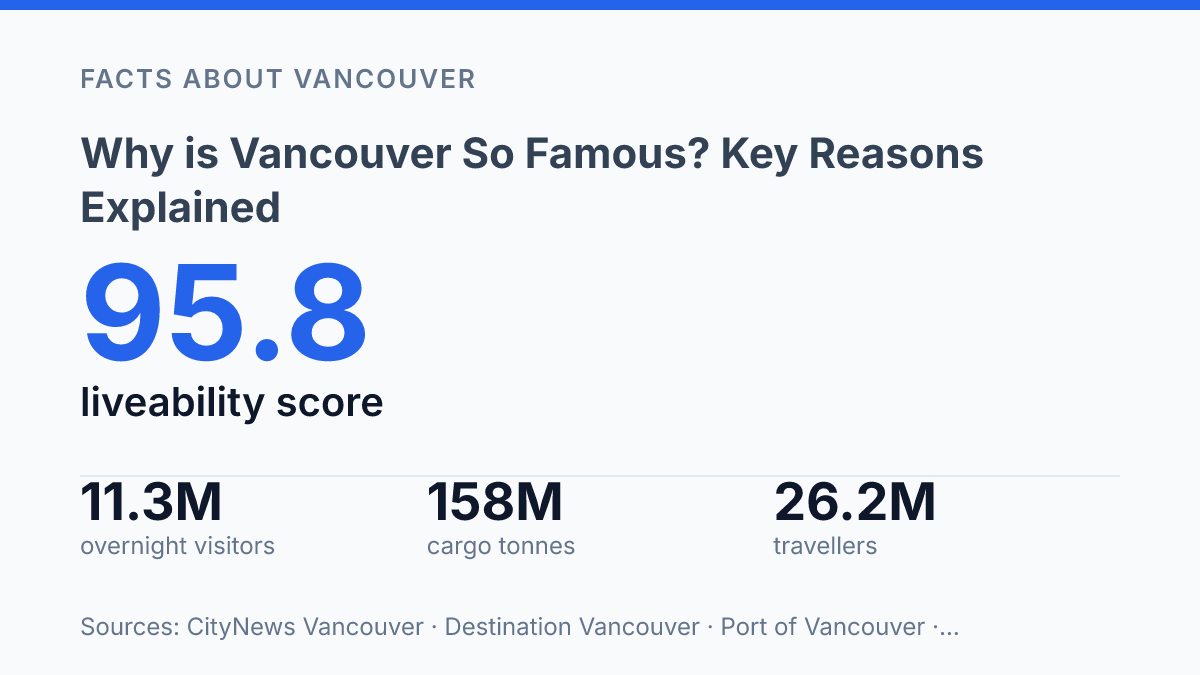
The answer to “Why is Vancouver so famous?” starts with a measurable split: in 2025, Vancouver ranked 10th globally for liveability while still facing some of Canada’s toughest housing pressure. That contrast explains why the city’s reputation travels so well and why locals often talk about it with a raised eyebrow. Vancouver is not famous for one neat reason. Its profile is built from overlapping roles: a Pacific gateway, a cruise and airport hub, a film-production centre, a growing tech market, and a place whose mountains-and-ocean setting still does a lot of unpaid marketing.
The numbers are not small either. Destination Vancouver reported 11.3 million overnight visitors, while the Port of Vancouver moved a record 158 million metric tonnes of cargo in 2024. The real story is how these strengths reinforce each other, and how the same demand that makes Vancouver visible also makes it expensive to live in.
What Made Vancouver Stand Out Internationally
Few big cities can sell a skyline where glass towers, skiable mountains, and ocean freighters all fit into the same postcard. Vancouver stands out internationally because its physical setting is unusually easy to understand at a glance: the city sits between the Coast Mountains and the Pacific Ocean, with downtown pushed onto a compact peninsula and water visible from many of its best-known viewpoints. That geography gives the city a clean global image before visitors know much about its neighbourhoods, politics, or economy.
Stanley Park, English Bay, and the seawall do much of the reputational heavy lifting. Stanley Park makes the city look greener and less hemmed-in than many urban centres, while English Bay gives downtown a beach-facing identity that is rare for a major Canadian city.
The seawall ties those images together in a practical way, turning the waterfront into something people can walk, cycle, photograph, and recognize. In travel coverage, that combination often becomes shorthand for Vancouver itself: outdoorsy, polished, ocean-facing, and close to wilderness without feeling remote.
That image is reinforced by formal liveability rankings, not just pretty pictures. In the Economist Intelligence Unit’s 2025 Global Liveability Index, Vancouver ranked 10th globally with a 95.8 score and was the top-ranked city in North America, according to CityNews Vancouver. Rankings like this matter because they convert a familiar travel impression into an internationally comparable claim about stability, infrastructure, services, culture, and environment.
The city’s profile also comes from its position as Canada’s major Pacific-facing hub. Vancouver is not only a scenic stop; it is a gateway for tourism, trade, and screen production, with cruise passengers, cargo routes, airport traffic, and film crews all reinforcing its visibility abroad.
That practical role keeps the city in circulation across business, travel, and entertainment networks, which is why its fame is broader than a mountain-and-ocean brand. The catch is that the postcard version can flatten reality: much of daily Vancouver is ordinary, expensive, work-driven, and logistical, even when the backdrop looks unusually good.
Which Industries Put Vancouver on the Map
Vancouver’s backlots have convincingly stood in for alien-conspiracy America and comic-book small towns, giving the city a pop-culture reach that travels farther than most civic branding campaigns. The long-running nickname Hollywood North comes from the depth of film and television work clustered in Metro Vancouver and across B.C., not just from a few famous productions.
The X-Files helped cement that reputation in the 1990s, while Riverdale later kept the region visible to a different generation of viewers. Creative BC’s 2024 estimates put the province’s motion-picture sector at $3.1 billion in GDP, $3.9 billion in direct output, 41,999 jobs, and more than 370 projects filmed, showing that the industry is a serious employer as well as a marketing engine.
The port gives Vancouver a different kind of global profile, one that is less glamorous but far more central to how the city functions economically. The Port of Vancouver is Canada’s largest port and a major trade gateway linking Canadian exports and imports with international markets.
In 2024, it moved a record 158 million metric tonnes of cargo, up 5% year over year, and connected trade with up to 170 nations, according to the Port of Vancouver. It also handled 3.47 million TEUs of containers, an 11% increase from 2023, which underlines the scale behind the cranes and container stacks visible around the harbour.
Tech has become a newer part of Vancouver’s reputation, though it should be kept in proportion. CBRE’s 2026 Scoring Tech Talent report ranked Vancouver ninth among North American tech-talent markets, one place higher than the year before.
That ranking helps explain why the city is increasingly associated with software, digital work, and innovation, but it does not make Vancouver equivalent in scale to the Bay Area, Seattle, or Toronto. Its tech identity is real, just more specialized and more modest than the loudest booster language suggests.
These industries do not land evenly in daily life. Film shoots are highly visible on certain streets, port activity is economically powerful but often felt indirectly, and tech growth benefits some workers far more than others. Together, they explain why Vancouver is known for more than scenery: it is a production centre, a trade machine, and a growing talent market, even if those strengths are not experienced the same way across the city.
How the City’s Reputation Affects Visitors and Residents
The 11.3 million overnight visitors reported in Destination Vancouver’s 2025 research are not an abstract popularity score; they show up as tour groups, restaurant lineups, hotel demand, and crowded public space in the parts of the city visitors already know by name. Downtown absorbs much of that pressure because it concentrates hotels, convention activity, shopping, nightlife, and waterfront access in a small area.
Gastown benefits from the foot traffic, especially for restaurants and retail, but it also has to carry the strain of heavy visitor use in a neighbourhood that is already dealing with visible social and street-level challenges. Granville Island faces a different version of the same problem: its public market and cultural spaces are major draws, but their popularity can make the area feel less like a local errand stop and more like a managed visitor circuit during peak periods.
Tourism money is real, and so is the dependence attached to it. Destination Vancouver’s 2025 research links visitor activity to $8.8 billion in tourism revenues, more than 66,000 jobs, and $3.1 billion in labour income.
That scale helps explain why the city markets itself so aggressively and why visitor-facing areas are kept polished. The practical tradeoff is that public space, transit routes, taxis, ferries, restaurants, and short-stay accommodation markets all feel the effects when global attention is concentrated into a relatively compact city.
Housing is the clearest place where Vancouver’s desirability turns into pressure for residents. CMHC’s 2025 Rental Market Report found that the purpose-built apartment vacancy rate reached 3.7%, the highest level since 1988, yet only about 1% to 2% of units affordable to lower-income households were vacant.
That contrast matters because a healthier headline vacancy rate does not automatically mean accessible housing for people earning local wages. Vancouver’s reputation attracts capital, newcomers, students, temporary workers, and high-income buyers, but the lived result is often a tight and expensive housing market.
The public image is clean, scenic, and highly marketable; the local conversation is more blunt. Affordability dominates for good reason, but it sits alongside concerns about transit crowding, uneven late-night service, neighbourhood change, and the everyday cost of staying in the city. Fame brings money and attention, but it also raises the stakes for basic urban services that residents use long after visitors have gone home.
The Short Answer for Readers Asking About Vancouver’s Fame
The shortest honest answer to “Why is Vancouver so famous?” is that Vancouver combines coastal scenery, a visible screen-production profile, and a Pacific Coast identity in a way few Canadian cities can match. Its image travels well because it is easy to recognize: water, skyline, forested edges, film backdrops, and a west-facing gateway role all reinforce the same outside perception. That fame is real, but it is not built from one source; it comes from the overlap between how the city looks, how often it appears in media, how it connects Canada to Pacific trade, and how its quality-of-life reputation circulates internationally.
Compared with Toronto and Montreal, Vancouver stands out less for sheer size or older cultural weight and more for its setting and west-coast position. Toronto is usually read as Canada’s biggest business centre, while Montreal carries a stronger historic and linguistic identity. Vancouver’s distinction is different: it is the Canadian city most closely associated with Pacific access, outdoor scenery, and a lifestyle image that international media can package quickly.
The practical factors still matter, though. Transport links, port activity, tourism infrastructure, and livability signals give substance to the image, even as local affordability pressures complicate the glossy version outsiders often see.
What Vancouver’s fame now puts under pressure
Vancouver’s reputation now functions less like a tourism slogan and more like a pressure test. A city that attracts global rankings, 11.3 million overnight visitors, major cargo flows, film crews, tech employers, and cruise passengers has to manage the consequences of being desirable. The harder question is not whether Vancouver deserves its fame, but whether its infrastructure, housing supply, and public services can keep pace with the attention it receives.
CMHC’s finding that only about 1% to 2% of lower-income affordable units were vacant shows the sharp edge of that problem. Fame brings money and visibility, but in Vancouver it also turns ordinary urban capacity into a daily local issue.
Frequently Asked Questions
Q: What is Vancouver best known for?
A: Vancouver is best known for its mountain-and-ocean setting, mild climate by Canadian standards, and easy access to outdoor recreation. It also has a strong film and television sector, which is one reason the city appears so often on screen.
Q: Why do so many movies and TV shows film in Vancouver?
A: The city offers varied backdrops, reliable production infrastructure, and a climate that allows filming to continue through much of the year. Lower production costs than many U.S. cities have also helped make it a preferred filming location.
Q: Is Vancouver really one of the most beautiful cities in Canada?
A: That reputation is grounded in geography rather than marketing. The city sits between the Pacific Ocean and the Coast Mountains, which gives it a rare mix of waterfront views, forested parks, and skyline scenery in one place.
Q: What makes Vancouver attractive to tourists?
A: Tourists are drawn by the combination of urban amenities and quick access to outdoor activities. Strong public parks, waterfront paths, and nearby ski, hiking, and biking options make the city appealing for short stays and longer visits.
Q: Why is Vancouver considered such a global city?
A: Its port, immigration history, and strong links to Asia and the Pacific have shaped a highly international economy and population. That mix gives the city a wider commercial and cultural reach than its size might suggest.