
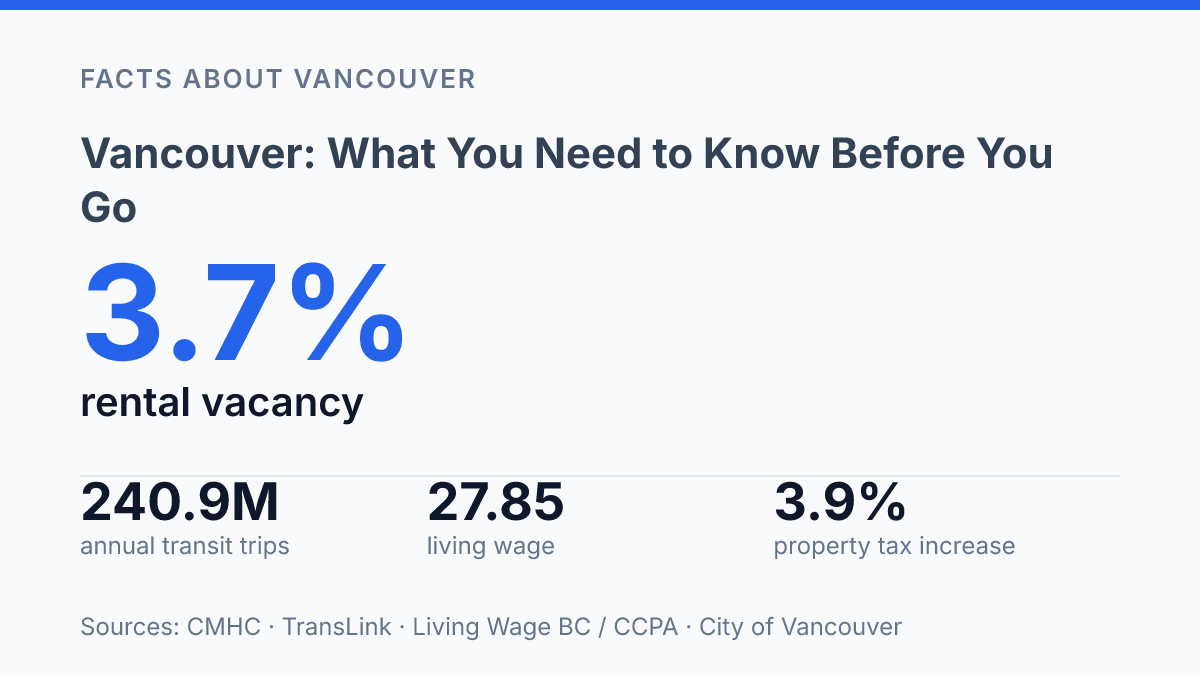
Vancouver can post a 3.7% purpose-built rental vacancy rate and still charge $2,363 for the average two-bedroom. That contradiction tells you more than any postcard view. CMHC put that in its 2025 rental report. It tracks with the bigger truth here: the city is easy to enjoy for a weekend, but hard to price out with confidence.
You’ll feel the payoff fast. Seawall walks, mountain views, late sushi. A SkyTrain ride that saves you from parking math. Then the tradeoffs show up.
A living wage at $27.85 an hour. Buses that can be packed before they reach you. Rain on 179 days a year, plus the occasional smoke week in summer.
This guide cuts through the brochure version. In my honest opinion, the real trick is knowing when the city rewards spontaneity, and when it punishes poor planning.
Why the city feels easy to love, and hard to live cheaply
The same postcard view that sells the city also explains why your budget starts sweating before you’ve unpacked. Vancouver gives you ocean, mountains, tidy streets, good coffee.
A level of polish that feels almost suspiciously easy to like. But the cost of staying close to all that beauty is the catch, not a footnote.
The 2010 Winter Olympics changed the city’s global profile fast. It didn’t create the appeal.
It pushed the place onto more travel lists, relocation plans, and investor radar screens. That spotlight helped sharpen the brand: outdoorsy, clean, Pacific, expensive.
Housing is where the dream gets blunt. Greater Vancouver Realtors reported a composite benchmark home price of about $1.17 million in mid-2025, which turns “maybe I’ll stay longer” into a serious financial conversation.
Renting doesn’t let you dodge the issue either: CMHC’s 2025 Rental Market Report put the average purpose-built two-bedroom rent at $2,363. The condo rental average at $2,900.
Neighbourhood choice changes the math more than visitors expect. Kitsilano puts you near beaches, yoga studios, cafés, and sunset walks that look like tourism ads. Surrey or parts of Burnaby can give you more space and better value. You trade some of that instant west-side lifestyle for commute time and a different daily rhythm.
That tradeoff matters because the city’s appeal is not fake. You can finish work and be near seawall paths, ski hills, beaches, or forest trails without making a whole weekend project out of it. In my view, that access is the strongest argument for paying the premium, but it’s also the thing that makes the premium so stubborn.
Wages don’t always soften the landing. Living Wage BC and the CCPA calculated the 2025 Metro area living wage at $27.85 an hour, exactly $10 above B.C.’s minimum wage of $17.85. That gap says the quiet part plainly: this place can feel wonderfully livable and financially unforgiving at the same time.
Getting around without wasting time or money
Every weekday, about 420,000 unique riders use the regional transit system, yet one bad bridge queue can still wreck a simple cross-town plan. That scale matters: according to TransLink’s 2025 report on 2024 data, the network recorded 240.9 million annual journeys.
This isn’t a token transit system. People rely on it.
For most trips inside the core, start with SkyTrain and fill the gaps with bus. The Canada Line is the cleanest move between downtown, City Hall, Richmond. The airport.
The Expo Line is the main eastward spine through Commercial-Broadway and New Westminster. If your route touches a station, don’t overthink it.
Peak-hour buses are the catch. TransLink reported that 11.2% of bus trips exceeded vehicle capacity at least once that year, which worked out to about 137,000 overcrowded trips. In my honest opinion, that’s why a “short” bus connection can be the weakest part of an otherwise smart transit plan.
Bridge math changes everything. The Lions Gate Bridge can turn a North Shore errand into a patience test, especially when lane control, rain, or a crash hits at the wrong time.
The Arthur Laing Bridge has the same problem for airport and Richmond trips: the distance looks harmless on a map. The approach can eat the savings.
Here’s the awkward truth. Transit is strong by North American standards.
A car can still win once you leave the core. That’s especially true for multi-stop errands, late-night trips, or anything that forces two buses and a long walk.
Biking works best when the route is flat and protected. City Active Mobility Plan materials list about 330 km of cycling network, but only 31% is rated suitable for all ages and abilities. That gap matters if you’re not comfortable riding beside traffic.
Best local rule: match the mode to the corridor, not your mood. Use rail for station-to-station trips.
Give buses extra time during commute hours. Drive off-peak if a bridge is involved.
Weather, seasons, and the stuff locals actually plan around
November doesn’t just feel wet; Environment and Climate Change Canada’s 1991–2020 Harbour climate normals put it at 245.2 mm of rain, compared with 43.5 mm in July. That gap explains local behaviour better than any forecast app.
People don’t cancel plans for drizzle here. They change shoes, choose a hooded jacket, and avoid jeans that stay damp until dinner.
The long wet stretch usually runs from October through March, and it’s less about dramatic storms than repetition. The same grey ceiling can sit over the city for days. Annual precipitation averages 1,537.4 mm, with measurable rain on 179.1 days, according to the same climate normals.
The mild winter is a selling point. The grey months wear people down faster than the temperature does.
Snow is a different story. At sea level, it can arrive, make a mess, then disappear into slush before the week is done. A few kilometres and some elevation change everything.
Burnaby Mountain and the North Shore can get heavier snow while downtown is just wet and miserable. That’s why locals check elevation, not just the temperature.
This is where planning gets oddly precise. If you’re heading to Simon Fraser University, Deep Cove, Lynn Valley, or a North Shore trailhead in winter, treat the forecast as incomplete unless you’ve checked road conditions too. In my humble opinion, the biggest rookie mistake is assuming one weather report covers the whole metro area.
Spring gives people a break, but not a guarantee. Cherry blossoms usually pull everyone outside before patio season has properly arrived. The photos look better than the weather often feels.
You can get soft pink streets, sideways rain. A cold wind in the same afternoon. Bring the layer you think you won’t need.
Summer is when the city changes pace. Beach days at Kits, Jericho, and English Bay become a real after-work option, not just a weekend plan.
July is usually the dry reward after the long soak, but recent summers have added another calculation: smoke. Metro Vancouver reported one air quality warning in 2024, lasting three days in early July, and wildfire smoke affected regional air quality in seven of the previous 10 years.
Winter still has one clean advantage: ski access. Grouse Mountain can feel close enough for a half-day escape when conditions line up. Just don’t confuse “nearby” with “effortless.” Rain below, snow above, traffic in between… that’s the local equation.
What locals know that guidebooks usually skip
The city’s slickest postcard version can point you toward its least memorable food. The better move is usually less polished: Richmond dim sum with a lineup of aunties, a tiny counter-service spot on Fraser, or coffee around Commercial Drive where nobody cares if your shoes are muddy.
Downtown gives you glass towers, hotel bars, and menus built for expense accounts. East Vancouver feels looser and more lived-in, with thrift shops, brewery rooms, old-school grocers, and restaurants that don’t behave like they’re auditioning for a travel spread. In my view, that contrast tells you more about the city than any lookout point does.
Dinner takes more planning than visitors expect. Good local restaurants can book up early, especially for Friday and Saturday.
A casual place may still expect you to reserve before the week gets away from you. Walk-ins happen, but don’t build your whole night around luck at 7:30.
Housing pressure also changes the mood on the ground. In CMHC’s 2025 Rental Market Report, the purpose-built rental vacancy rate reached 3.7%, but average two-bedroom rent still hit $2,363, up 2.2%. The condo rental market sat at 1.5% vacancy with a $2,900 average two-bedroom rent, according to CMHC.
That doesn’t just affect renters. It shapes staffing, hours, prices. The quiet edge you’ll notice when locals talk about “nice” neighbourhoods.
Granville Island Market is still useful, but treat it like a local errand with snacks, not a sacred attraction. Go with a short list, buy something specific, then get out before the slow shuffle takes over. The city rewards that kind of decisiveness.
Polite distance is another local habit. People will help with directions, hold a door, and apologize when you bumped into them. They may not launch into small talk.
Don’t mistake that for coldness. Here, the warmest places are often the least curated ones.
What the smartest visitors build into the day
Plan your trip like a local plans a Tuesday: leave slack, check the route, and don’t trust the sky just because it’s blue at breakfast. In 2025, costs are the part most visitors underestimate, but timing is the part that quietly shapes the day.
Use TransLink before you book a car. Pack for wet pavement, not just rain. Keep one indoor backup for every outdoor plan.
And if the bus looks full, it’s not your imagination. The region recorded 137,000 overcrowded bus trips in 2024.
In my humble opinion, the smartest visitors don’t try to beat the city. They work with its limits.
That’s how you get the good version: less waiting, less spending. A lot fewer rookie mistakes.
Frequently Asked Questions
Q: What’s the best time of year to visit Vancouver?
A: Late spring through early fall is the sweet spot. July usually gives you the driest weather, and 1.6 million people show up each year for the city’s tourist season, so you’re not the only one chasing clear skies. In my view, if you hate rain, don’t gamble on winter unless you really want that moody West Coast experience.
Q: Do you need a car in Vancouver?
A: No, not for a city trip. Transit, walking, and rideshares cover most of what you’ll actually want to see, and driving can turn into a slow, expensive headache fast. A car helps if you’re heading out to the mountains or farther up the coast, but inside the city it’s more trouble than it’s worth.
Q: How many days do you need in Vancouver?
A: Three full days is the bare minimum if you want a real feel for the city. That gives you time for downtown, the seawall, and one neighborhood meal that doesn’t feel rushed. If you only have a weekend, you’ll see the highlights but you won’t get much breathing room.
Q: Is Vancouver expensive for tourists?
A: Yes, and there’s no clean way around it. Hotels, dining, and parking can add up fast, especially in peak season. The upside is that the city gives you a lot for your money if you spend smart… free waterfront walks, public markets, and great views don’t cost a thing.
Q: What should I pack for Vancouver weather?
A: Bring layers, a light rain jacket, and shoes you don’t mind getting wet. The weather changes fast. A sunny morning can turn gray by lunch… that’s just normal here. A compact umbrella helps. A good jacket matters more.